
Fac Potiones Excellens
Tipples → Alcoholic Beverage Products → Distillates → Spirits → Direct Spirits → Whiskies → Rye Whiskies
Pennsylvania (style) Rye Whiskies
Jump to: Description | Mash Bills | History
Description
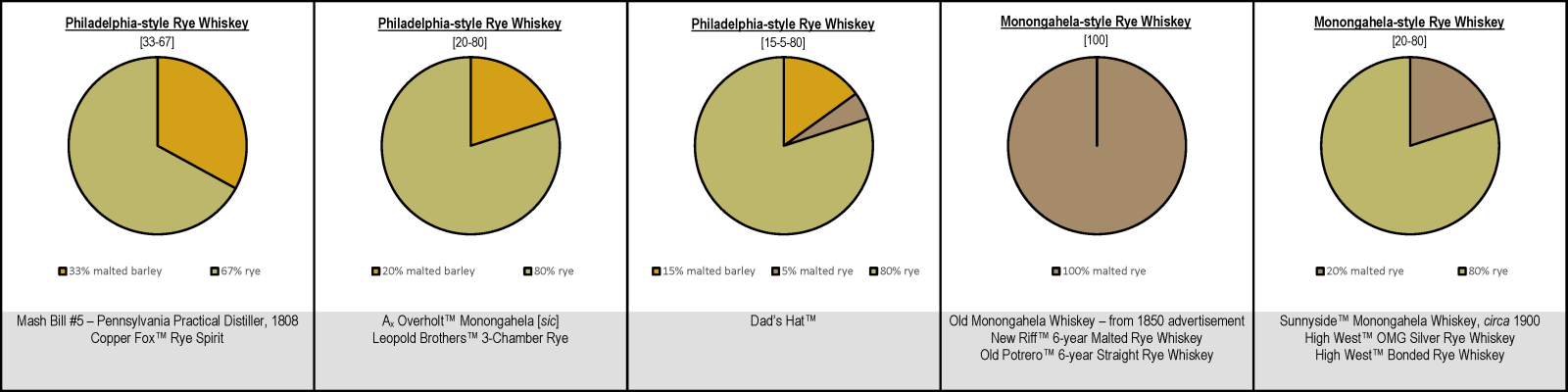
Pennsylvania-style Rye Whiskey is distilled from a maizeless, mostly-rye mash, but traditionally with at least 10% of it being either malted barley or malted rye.
Philadelphia-style Rye Whiskey

Philadelphia-style Rye Whiskey is distilled from a mostly-rye mash, but traditionally with at least 10% of it being malted barley.

Monongahela-style Rye Whiskey is distilled from a maizeless, mostly-rye mash, but traditionally with at least 10% of it being malted rye.
Mash Bills
History
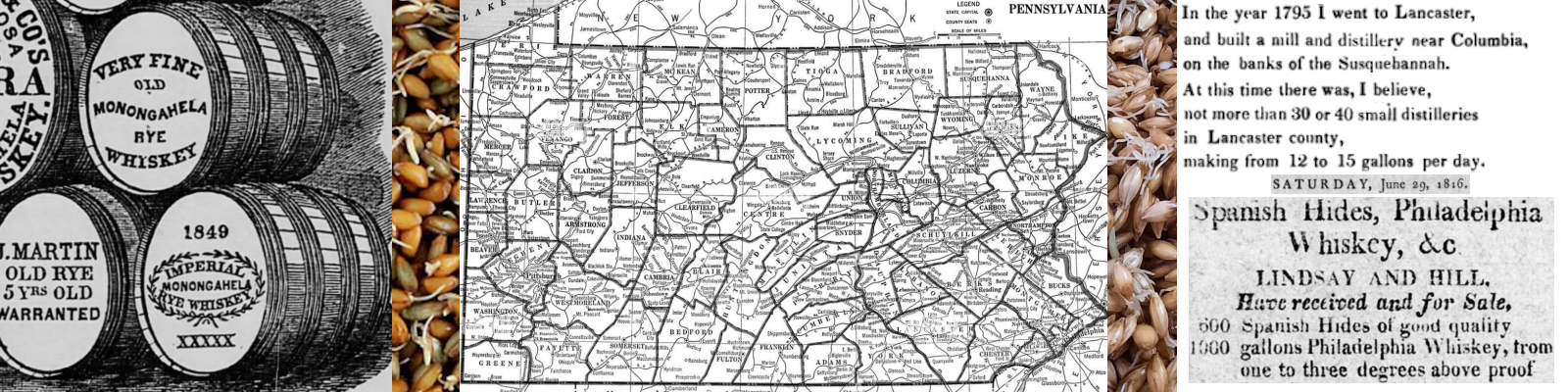
Rye whiskey distillation begain in the rural belt around Philadelphia area before the year 1795 – perhaps significantly before then. It surely evolved as farmers mixed rye in with barley as they adapted the familiar all-barley whiskies of the old world to local conditions that made barley less efficient a crop to grow. Enough barley was continued in use for fermentation, and to give the whiskey the centuries-old flavor note expected throuhgout the Anglo-Celtic diaspora.
The Monongahela style of rye whiskey began some time shortly after the year 1795 along the Monongahela river of western Pennsylvania and the border region of north-western Virginia (now West Virginia). With the surplus of rye grain that was quickly available, all-rye whiskey was distilled there. But the middle of nineteenth century, Monongahela whiskey was advertised as being "pure-rye" or "all-rye" as an indicator of quality.
In these times of focusing on whether a rye whiskey is "barely legal," usually contiguous with maize content, some have mistakenly conluded that any rye whiskey containing no maize is somehow a Monongahela-style rye whiskey. There has also been some faddish assumption that Monongahela-style rye whiskey is superior. This is, as it always has been, a matter of taste. There has also been a drive to get Monongahela-style rye whiskey regulated as an identity. The historic distillers above didn't much concern themselves with such. They made whiskey to the extent that they cared about their reputations, and they let the public pursue it. They did not need a new regulation to make good whiskey.
But, some words do become faddish. Some people employing the fad become interested in having the bureaucrats define the fad in their favor. We might see the essential nature of Pennsylvania's other great whiskey, the Philadelphia style, defined as the Monongahela style. Neither style was historically understood to contain any maize. In the Phialdelphia-style, barley was commonly used, and in no tiny amount. It is the Maryland-style of rye whiskey that innovated the honest use of maize to fill in a mash – and not necessarily to inferior effect. This created what was the main type of rye whiskey for a century. Wild Turkey 101 rye whiskey is a good example of the corned, Maryland-style tasting delicous and doing a stout job of mixing. Rittenhouse is another example.
It is true that all-rye whiskies were sometimes made in the Philadelphia and Maryland whiskey regions, but they were exceptions in contrast to the emerging main styles. Likewise, barley was sometimes used in making Monongahela whiskey. Furthermore, I have no doubt that some whiskies made with undeclared maize content were also sold as "Monongahela." However, the expectation, advertising, and demand, remained focused on the all-rye mainstream desideratum. No old advertisement of any Monongahela rye whiskey that I have ever seen suggests that it includes barley or maize. Many historic advertising explicitly proclaims the whiskey being "all-rye" or "pure-rye."
If the imperfectly educated industry, and the bureaucrats who understand even less, get the Philadelphia-style defined as the Monongahela-style, such ignorant manipulation will not have been the first instance of such. It will not alter reality – nor history. I must also assert that in one way, at least, Philadelphia-style rye whiskey is better in that by being made from a significant amount of malted barley, it has more of whiskey flavor that has defined the spirit for a millenium. It might also predate the Monongahela-style. If I were producing a delicious Philadelphia-style rye whiskey, in the Philadelphia area, I would resist the urge to change my label to cram the word "Monongahela" in. One must not chase fad. One must force the fad to chase your product, because of its superior nature. Also, an historic distiller of the Monongahela style has now adopted the Philadelphia style mash bill as they re-launch their old label, alleging the continuation of the Monongahela style. Such is the way of things.Luckily, the educated drinker can find whiskies within these pages that are analogs of the what was preferred in the historic Monongahela-style of rye whiskey, or in the older, more traditional flavor, of the Philadelphia-style.
* When using Amazon links from this site, a very small fraction might be paid to Elemental Mixology without affecting the purchase price.