
Fac Potiones Excellens
Tipples → Alcoholic Beverage Products → Distillates → Spirits → Direct Spirits → Whiskies → Rye Whiskies
Maryland (style) Rye Whiskey
Jump to: Description | Mash Bills | Bottlings | Best-selling Brands | Tasting and Usage Notes | Noteworthy Drinks | History
Description

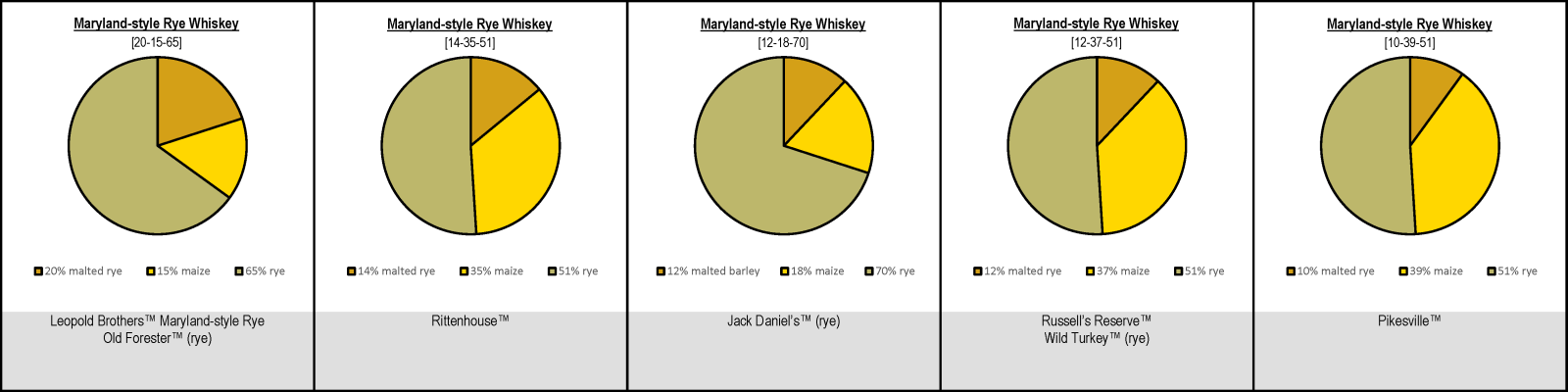
Maryland-style Rye Whiskey is distilled from a majority-rye mash, but traditionally with at least 10% of it being malted barley – and a considerable amount of maize. The above image shows a common proportion of 12% malted barley, 37% maize, and with 51% rye.
Mash Bills
Bottlings

Best-selling Brands
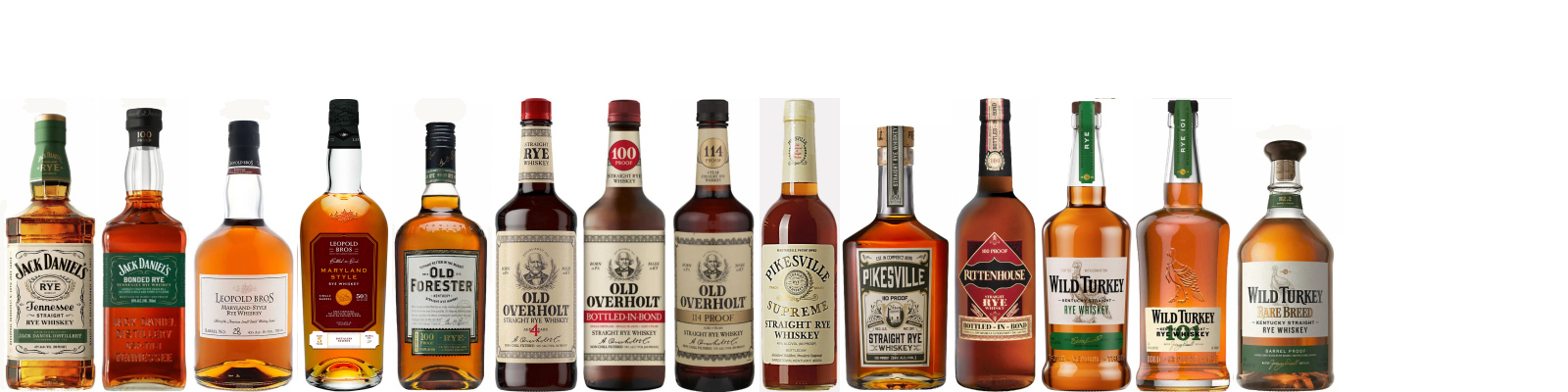
The following Maryland-style rye whiskies are the sales leaders, in order by brand (not by specific bottlings):
- Jack Daniel's (rye whiskies only)
- Wild Turkey (rye whiskies only)
- Old Forester (rye whiskies only)
- Old Overholt (not including A. Overholt, a Pennsylvania-style rye whiskey)
- Rittenhouse
- Pikesville
Tasting and Usage Notes
If the spirit has not been overaged, the barley in a good Maryland-style rye whiskey should give an initial taste of buttery porridge. This is the whiskey note. Next, the taster will become aware of the spicy, and nutty, notes from the rye grain, followed by an intimation of sweetness from the maize. If the whiskey has been aged, but not overaged, the flavor of the barrel will 'polish' the already-mentioned whiskey-and-spice flavors with hints of caramel from the char, and the sweet hint established by the maize will gain depth from the sweetness of the wood, itself.
At Elemental Mixology Wild Turkey 101° proof Rye Whiskey is commonly used in all applications. It is good enough for Thoroughbred drinking and Slings, while not being too expensive for Grogs, Punches, and Possets.
If one must save a little money, the slightly-rougher Rittenhouse is no longer the answer. It is now virtually as expensive as Wild Turkey 101 Rye.
Old Forester and Old Overholt will still save you a few dollars per bottle in the 100° proof range, but they are most suitable for Grogs, Punches, and Possets.
Jim Beam rye whiskey would have made this list on sales stregth, but that product is only nearly a Maryland-style rye whiskey. It is thought to be made of a mash containing only 10% barley.
Pikesville Supreme, at 80° proof, was once the best value-per-dollar for anyone wanting a mild, well-distilled, not-very-complex, Maryland-style rye whiskey. It was selling for $10-$15 per 750 milliliters when Heaven Hill discontiued it to devote the distillate to more profitable bottlings.
Noteworthy Drinks
Bar favorites, such as the Rock & Rye, Whiskey Highball, Whiskey Cocktail, Manhattan Cocktail and the Whiskey Sour were surely first, or commonly, made with Maryland-style rye whiskey during nineteenth century.
Thoroughbreds
- Rock and Rye
Grogs
- Whiskey Cooler (also called "Whiskey and Soda")
- Whiskey Highball (also called "Whiskey and Soda")
- Whiskey and Ginger Ale (pre-prohibition style)
Slings
- Whiskey Cocktail (pre-prohibition style)
- Old-fashioned Whiskey Cocktail (pre-prohibition style)
- Manhattan Cocktail
- Old Manhattan Cocktail
Punches
- Whiskey Sour (pre-prohibition style)
History
After Pennsylvania-style rye whiskey had reached its stable form, Maryland-style rye whiskey became the second type of rye whiskey to achieve a discernable identity in North America.
With an essential nature that might be called, "corned rye," Maryland-style rye whiskey evolved in the awareness that a fair amount of inexpensive maize could be added to the barley and the rye without their flavors being lost in the resulting whiskey.†
Maryland-style rye whiskey was probably the most common type of whiskey used in American bars and homes during the golden era of A.D. 1860 - 1910, especially as the years progressed within that time frame.
† Maryland-style rye whiskey should never be dismissed as "barely legal." This pejorative term ignores the critical role of barley – historically the most expensive and flavor-dense grain in the mash. A sort of 'whisper campaign' in the industry has convinced many that "pure" rye means "better" rye. This usually results in a cheaper-to-produce spirit that lacks the buttery structural depth that only significant barley malt can provide. While modern marketing-driven trends favor "whiskeyless" spice and high-rye percentages, true aficionados recognize that 12% to 15% barley content isn't a legal shortcut. It is a commitment to a sophisticated, historical flavor profile that the supermajority ryes simply cannot replicate. To call such a spirit "barely legal" is to admit a lack of understanding of the distiller's craft and the traditional flavor of whiskey.
* When using Amazon links from this site, a very small fraction might be paid to Elemental Mixology without affecting the purchase price.