
Fac Potiones Excellens
Tipples → Alcoholic Beverage Products → Distillates → Spirits
Geist Spirits
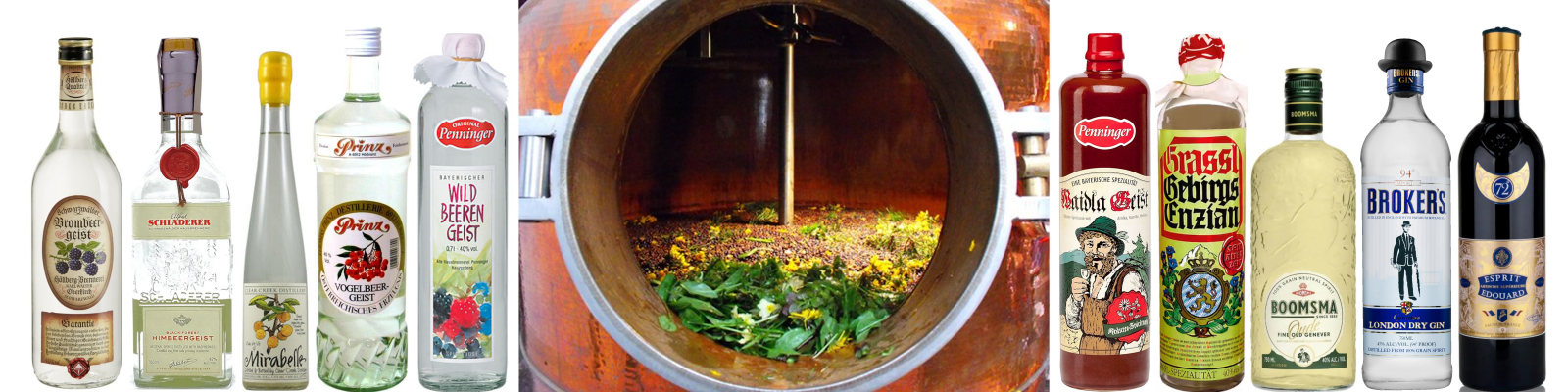
Geist Spirits are distilled for flavor and aroma from unfermented ingredients. This is normally accomplished by maceration of the ingredients in spirits before secondary distillation.
The geist method is the best option if the desired source ingredient cannot be naturally fermented, or if its flavor and aroma are not advantageously caputred by fermentation.
Geist spirits fall under two categories: those distilled from fruits (above left), and those distilled from other botanical ingredients (above right).
FRUIT GEIST SPIRITS

Fruit Geist Spirits are mostly produced in Germany and France. They include: Himbeergeist, or Eau de Vie de Framboise, distilled from macerated raspberries; Mirabellengeist, or Eau de Vie de Mirabelle), distilled from macerated yellow plums; Wildbeerengeist disitlled from macerated mixed wild berries; and many others of this type.
FRUIT GEIST SPIRITSBOTANICAL GEIST SPIRITS

Botanical Geist Spirits are produced in Germany, Germanic countries, France, and everywhere gin is made. They include Steinhägergeist (juniper), genever (juniper, plus), English-style gin (juniper, plus), esprit d'absinthe (wormwood, plus), Scandinavian aquavit (caraway, plus), Lebanese arak (aniseed), Greek ouzo (aniseed, plus) and many more with realms of flavor undiscovered by Anglophone mixologists. These include bärwurzgeist, waidlageist, and tonka bean geist.
BOTANICAL GEIST SPIRITSGeist-distilling is not culturally at home in the English-speaking world. The one geist spirit that has taken root in the Anglophone world is gin. Beyond that, English-speaking distillers do not often think of the process. The T.T.B. in Washington D.C. even tends to think of geist distilling as "the gin process." This is rank ignorance. For example, Curaçao liqueur is made by sweetening a geist spirit distilled from the peels of bitter oranges. In the English-speaking world, this underlying noble spirit of orange peel is often not considered of high quality unless it is blended with Cognac brandywine. Such cultural blindness is a major cause of most high-quality Curaçao liqueurs having disappeared. Some are discontinued, others suffer the failure to be imported (by Hotaling, rejecting a perfect product), while others are mostly poured into Cognac brandywine (by Lapostolle and Ferrand). We English speakers of the spiritous world should learn to respect the geist more than we do. We would not consider a good gin inferior for lacking a "brandy base," would we? And there is plenty more to learn and respect in geist than just gin.
In the making of English-style gin, Carterhead distillation by simply passing the vapors of redsitilled alcohol through a basket containing the botanical ingredients has gained ground. This type of process has the advantages of producing an aromatic spirit that is also low in flavor - while not requiring the knowledge of optimal duration of maceration for each botanical ingredient. It should be thought of as gin-distilling with 'training wheels'* - so to speak. It produces a spirit that smells like gin more than it tastes like gin. This compromised flavor may be more accesible to masses of vodka drinkers, but it ought to be embarrasing. In my opinion, the Carterhead should only be used when it is desired to increase aroma where there is already flavor. It should not be used to substitute aroma for flavor. I am a cook as well as a bar-tender, and I am loyal to flavor.
* That the same sort of fake-standard upholders who call Maryland-style rye whiskey "barely-legal" fail to call Carterhead gin "training wheel gin" is to be expected, I suppose.