
Fac Potiones Excellens
Tipples → Alcoholic Beverage Products → Distillates → Spirits → Geist Spirits
Botanical Geist Spirits
Jump to: overview | aniseed geist spirits | baldmoney-geist-spirits | caraway geists spirits | gentian geist spirits| juniper geist spirits | wormwood geist spirits
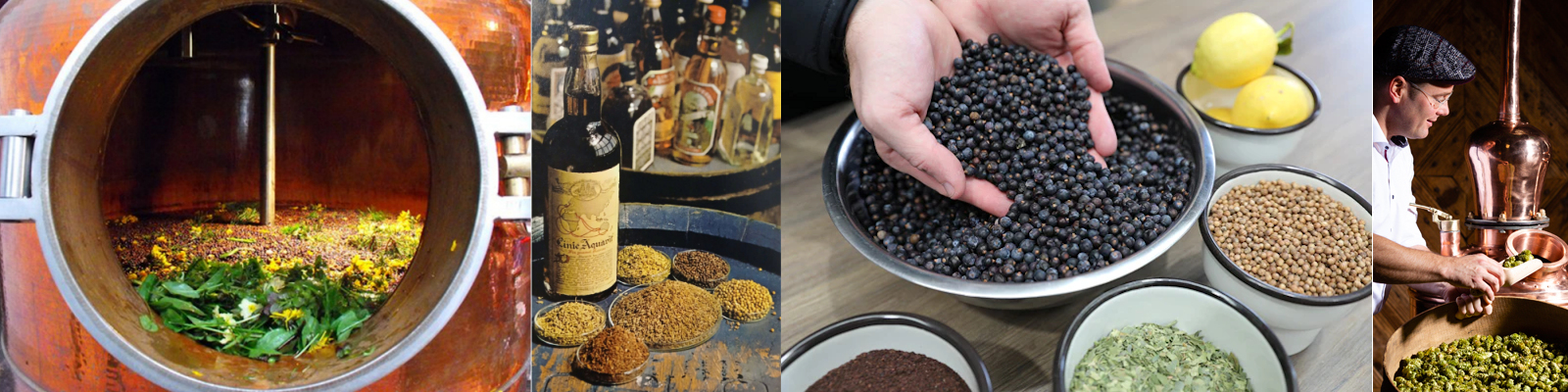
Botanical geist spirits are simply medicinal plants put into stable form. This type of spirit, more than any other, is medicine – or the recreational adaptation therof.
Aniseed Geist Spirits

Aniseed geist spirits are distilled from macerated aniseed (Pimpinella anisum) – and sometimes other ingredients.
Baldmoney Geist Spirits

Baldmoney geist spirits are distilled from macerated baldmoney (Meum athamanticum), known in Germany as bärwurz, with other ingredients.
Caraway Geist Spirits

Caraway geist spirits are distilled from macerated caraway (Carum carvi) – and sometimes other ingredients.
Gentian Geist Spirits

Gentian geist spirits are distilled from macerated gentian (Gentiana), with other ingredients.
Juniper Geist Spirits

Juniper geist spirits are distilled from macerated juniper (Juniperus communis) – and sometimes other ingredients.
Wormwood Geist Spirits

Wormwood geist spirits are distilled from macerated wormwood (Artemisia absinthium) – and sometimes other ingredients.
OVERVIEW
It is a relatively simple matter to begin distilling botanical geist spirits. The first spirit ever distilled as an Elemental Mixology product was a classic esprit d'absinthe distilled in the autumn of 2006. It came out remarkably good, rivalling the best absinthe blanchettes when proofed down a bit. Those who tasted it in the week following, before it was all consumed, have periodically asked about having some more. Given that more than a dozen botanical ingredients were used, the only reason that such a first effort was a success was in following the geist bill from an old distilling manual book published in France.
To compose a geist spirit without a pre-existing gesit bill to follow, and have the first batch come out delicious, might require a lifetime of experience with geist-distilling from macerated botanical ingredients of many types.
Some botanical ingredients support others in ways that might not be obvious to tipplers and bar-tenders. The distiller of geist spirits is not just blending flavors and aromas from different plants. He, or she, will also be thinking of ingredients that act as 'fixatives' or 'bridges.'
A fixative ingredient is one that provides density that will keep flavorful and aromatic compounds of other ingredients from being vaporized, and lost, during distillation. A classic example of a fixative ingredient is orris root. Its presence prevents loss of flavor and aroma from citrus.
A bridging ingredient is one that has flavor or aroma that heightens that of another ingredient. In juniper geist spirits, such as genever and English-style gin, coriander is a bridge ingredient that brings out character from the juniper cones. Coriander bridges character between many other pairs of ingredients, also.
Another realm of knowledge important to traditional geist distillation is maceration duration. In a single-batch maceration, in which all of the botanical ingredients are macerated together, awareness of the ideal maceration duration for each ingredient is valuable knowledge that is not committed to any "Encyclopedia of Geist Distillation." But some general proinciples of maceration duration are widely known. For example, fresh herbs like lemon balm or costmary render their aromatic and flavorful compounds almost immediately once in contact with the macerative spirit. Leaving them in longer than a few hours will start to produce off-putting 'grassy' flavors. On the other hand, sloes (the berries of the blackthorne bush), with their thick skin and waxy outer layer, require up to a week for the macerative alcohol to extract their flavor. It is also widely known that macerating any botanical ingredient past about fourteen days will create 'muddy' flavor. This is one reason that most botanical ingredients are macerated for only up to a week.
In practical application for a single-batch botanical geist spirit, the distiller begins by firstly adding the most hardy and woody ingredients to the macerative spirit, already in the pot of the still or another container. If the most hardy ingredients are intended for a seven-day maceration, they will be added seven days before the day that the geist spirit will be distilled. The next day, and ingredient best macereated for six days will be added, and so on. If fresh herbs like mint or costmary are to be added, they might be added at five o'clock in the morning when distillation is set to begin three hours later.
Many new distilleries have begun operations without a distiller having this knowledge. Also, some corporations owning long-standing products no longer wish to pay for such expertise. In either of these situations, doing simple twenty-four-hour macerations, or using the Carterhead still in which the botanical ingredients are held in a permeable metal basket through which distilled alcoholic vapor is passed through them, is used. It should be noted that Carterhead distillation of geist spirits has the capacity to create spirits that have more aroma than flavor, which may have advantagous applications. But, in general, Cartehead distillation and twenty-four-hour short maceration are methods that can justifiably be thought of as geist distillation with training wheels that often produces lower-flavor spirits.
Another method to prevent spoilage of and entire maceration by error with one ingredient is to distill separate single-botanical geist spirits, and then blend them together. Some distillers do this, or a version of it, for both German root spirits and London-style gins.