
Fac Potiones Excellens
Tipples → Alcoholic Beverage Products → Distillates → Spirits → Direct Spirits
→ Whiskies
Barley Whiskies
Jump to: Description | Scotch Barley Whiskies | Irish Barley Whiskies | Welsh Barley Whiskies | American Barley Whiskies | Canadian Barley Whiskies | Austraian Barley Whiskies | New Zealand Barley Whiskies | Indian Barley Whiskies | Japanese Barley Whiskies

All-Barley Whiskies are distilled from an all-barley mash, of which some, or all, will have been malted.

Majority-Barley Whiskies are distilled from a majority-barley mash, of which some, or all, will have been malted – plus minority amounts of other grain.
Barley-Whiskey-Blended Grain Spirits

Barley-Whiskey-Blended Grain Spirits are made by blending barley whiskey with grain spirit, usually with the latter being the majority.
.Description
Both of the above have been traditionally distilled in copper pot stills that are of similar descriptionos. Some differences are seen, though. A taller pot-still will distill a more refined spirit that is both cleaner and lower in flavor. Lyne arms, or lye pipes, of various angles also result in differenct character. A downward-angled lyne arm will allow heavier, more flavorsome, compounds into the finished product. One that is horizontal will let more of those compounds fall out of the vapor and not make it into the distillate. The water used to down-proof the distillate, and the wood of the barrel, will each affect the flavor of the whisk(e)y.
Barley whiskies are especially associated with various countries and regions.
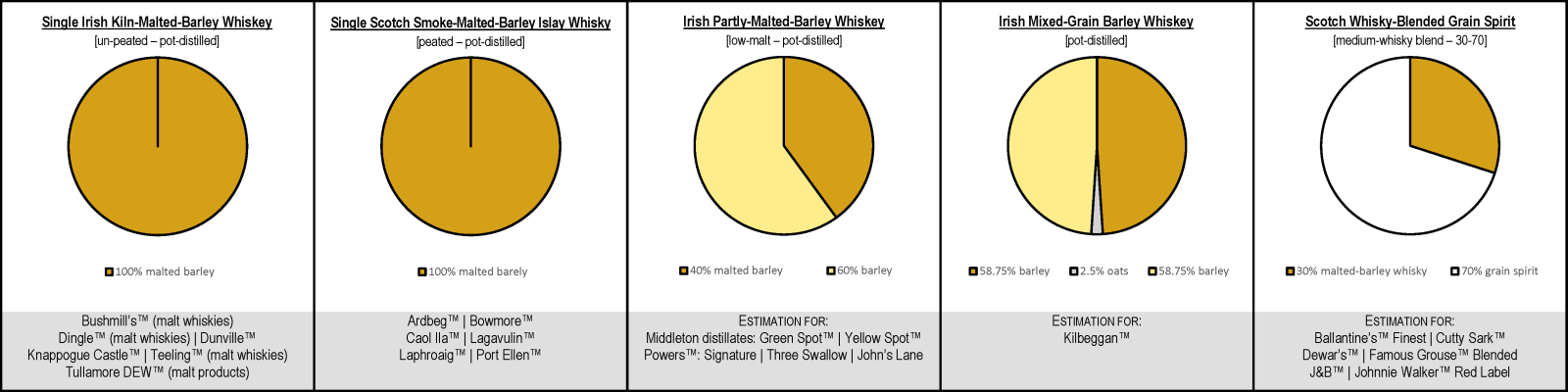
- Scotland — Scottish, or Scotch, whiskies are archetypally distilled from a mash of oure barley, all of which will have been malted. It will have often been smoke-malted using peat as fuel. When the whisky is bottled from whisky distillate of a single distillery, it is considered a single whisky. The full descriptive names, "single, malted-barley, Scotch whisky" and "single, peat-malted-barley, Scotch whisky," are usually abbreviated to 'single malt Scotch.' Typical for English, this abbreviation discards the noun (whisky), and other words. This can leave unclear what 'single' applies to, and what 'malt' means. For purposes of clarity and elucidation, Elemental Mixology uses the fuller, more meaningful name. When multiple single whiskies are blended together in a vat, the whisky bottled from such a mixture is "blended, malted-barley, whisky." It was formerly called "vatted, malted-barley whisky." That term is no longer allowed for labeling by Scottish regulation. "Blended malt whisky" is the common abbreviation. Traditionally, all whisky distilled in Scotland was from peat-malted barley. This use of the cheapest fuel available had the consequence of the smokling the barley, creating a smoky flavor in the whisky. When malted-barley whisky blended with grain spirit, it will commonly be called "blended Sctoch." This is unfortunate for more than one reason. Firstly, confusion is created between what is commonly called "blended malt" and "blended Sctoch." Secondly, in Scotland, Ireland, and some other whisk(e)y-producing countries, grain spirit, a distillate more like unrefined vodka than whisk(e)y, is legally called "grain whisk(e)y" so that regulated product labeling doesn't make a mockery of itself - at least in the fictions of law - for a product made of a majority of such substance. Here such a blend will be, "whisky-blended grain spirit."
- Ireland — Irish whiskies where vitually the same as Scotch whiskies until the 18th century. By the latter half of that century, prefference for tripple-distillation was growing in Ireland. The malt tax of 1785 caused Irish whiskey makers to begin to mix unmalted barley with malted barley to avoid some part of that tax cost. By the 19th century, this had also led to the use of oats and rye in the mash for Irish whiskey. The use of other grains was minimized by 20th century, and 21st century, regulation, but there is interest in allowing broad-grain mash-bills again under specific labeling identities.
- Wales — Distilling of barley whisky probably spread to Wales within a century of the same in Scotland. It is currently produced using mostly the same methods and terms as in Scotland.
- America — Radiating with British culture, early distilling of pure barley whisky likely occurred in the American colonies in the 1620s, was quickly abandoned in favor of rye and maize, and was recommenced in the 1990s. It is currently produced using mostly the same methods and terms as in Scotland, though "straight malt whiskey" would be allowed to contain other grains.
- Canada — Radiating with British culture, early commercial distilling of barley whisky began in Canada around the year 1790. It is currently produced using mostly the same methods and terms as in Scotland.
- Australia — Radiating with British culture, early commercial distilling of barley whisky began in Australia around the year 1822. It is currently produced using mostly the same methods and terms as in Scotland.
- New Zealand — Radiating with British culture, early commercial distilling of barley whisky began in New Zealand around the year 1835. It is currently produced using mostly the same methods and terms as in Scotland.
- India — Radiating with British culture, early commercial distilling of barley whisky began in India around the year 1827. It is currently produced using mostly the same methods and terms as in Scotland.
- Japan — The most celebrated expanision of barley whisky outside the British diaspora has been commercially distilled in Japan since the year 1924. It is currently produced using mostly the same methods and terms as in Scotland.
* When using Amazon links from this site, a very small fraction might be paid to Elemental Mixology without affecting the purchase price.