
Fac Potiones Excellens
Vessels → Goblets
Cocktail Goblet
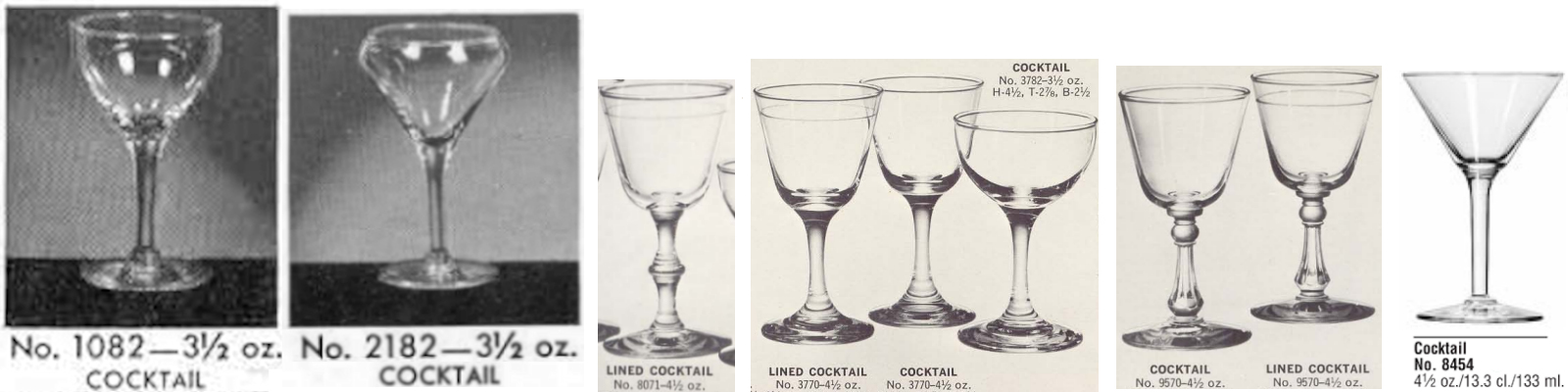
Above, from left to right:
- Libbey Metropolitan 3½ fl-oz. Cocktail #1082 (1940 catalog)
- Libbey Royal 3½ fl-oz. Cocktail #2182 (1940 catalog)
- Libbey Georgian 4½ fl-oz. Lined Cocktail #8071-L (1973 catalog) search on e-Bay
- Libbey Embassy 4½ fl-oz. Cocktail #3770 (1973 catalog) search on e-Bay
- Libbey Embassy 4½ fl-oz. Lined Cocktail #3770-L (1973 catalog) | new pack of six (without line)* search on e-Bay
- Libbey Embassy 3½ fl-oz. Cocktail #3782 (1973 catalog) search on e-Bay
- Libbey Columbian 4½ fl-oz. Cocktail #9570 (1973 catalog) search on e-Bay
- Libbey Columbian 4½ fl-oz. Lined Cocktail #9570-L (1973 catalog) search on e-Bay
- Libbey Citation 4½ fl-oz. Cocktail #8454 (2000 catalog) search on e-Bay
The Cocktail goblet represents the compromise between cold-preserving depth, and bitter-aroma releasing width. When drinking a true Cocktail, also called bittered Sling, the aroma of the bitters must reach the drinker's olfactory system to subconsciouly distract him, or her, from the fumes of ethanol. This makes the true Cocktail taste like the spirit it has been made of, but with all sensation of harshness removed. Anyone who still thinks bitters in true Cocktails are for 'lifting' or 'brightening' or 'binding' or 'accenting' flavor should catch up with what drinkers and bar-tenders have known for more than two hundred years.
The modern method of stirring Slings of all subgenres (modern ignorance calls them 'liquor-forward drinks') through ice, is followed by straining them into chilled goblets for perfectly-cold, ice-free, stemmed service. This allows the prevention of further ice-driven dilution, while providing a stem with which to hold the drink without warming it.
The Cold War era obsession with the Old-Fashioned Whiskey Cocktail – often now served in heavy tumblers with oversized ice – presents us with the triumph of image over mixology and thermodynamics. It has become a hackneyed prop for those wishing to project a rugged persona, including the professional sets of Beverly Hills who equate the weight of the glass with strength of character. In reality, they are choosing the version of the Cocktail that constantly retreats into dilution. This is why bar-tenders wrote over a hundred years ago that the old-fashioned form of the Cocktail was good for elderly patrons with weak stomachs.
The Cocktail goblet was introduced sometime between the years 1865 and 1875. It was innovated to give the hugely-popular modernized Cocktail dedicated glassware that would keep some part of the drink deep, and cold, while being wide enough at the surface for the Cocktail subgenre to work upon the drinker's olfactory system as intended. It replaced the ad hoc use of the claret goblet.
Cocktail goblets in capacity as small as 3½ fl-oz. can be used to serve fancy Cocktails with all sweetness within the jigger, being no larger before stirring than the jigger and two dashes of bitters.
Smaller Cocktail goblets were also commonly home to full-recipe Cocktails when smaller amounts of ice were used to stir them before straining. If a full-recipe Cocktail is stirred only briefly with two or three cubes of ice, it will not become as cold, nor as diluted, as the same recipe of ingredients stirred through plenty of ice. This is why Cocktail goblets of a hundred years ago were sometimes produced with the capacity of only about 2½ fl-oz.
For plain Cocktails, and others containing syrups or sugar outside the jigger, the standard Cocktail goblet with 4½ fl-oz. capacity is appropriate.
The use of plenty of ice and stirring long enough to make a Cocktail fully cold before straining it into a full-size Cocktail goblet is considered best practice at Elemental Mixology.
Some Cocktail goblets were historically produced with fill lines. The purpose of the line was to ensure that the Cocktail had been stirred long enough to add enough alcohol-melted ice water to make the drink sufficiently cold. If the drink were made with the proper recipe, stirred, strained and failed to reach the fill line, it would not be cold enough to serve. This kept bar-tenders from stirring the drink too briefly in the rush of service.
Having the use of one of these goblets is convenient and instructive. If a strained true Cocktail fails to reach the proper chill-dilution, and the fill line, it is not cold enough yet. It should be poured back into the mixing pitcher for further stirring (assuming the same drink's method ice is still inside).
The so-called "Martini glass" [sic] is a Cocktail goblet with a stylized shape, unveiled at the International Exhibition of Modern Decorative and Industrial Arts in the year 1925 at Paris, France. It was then still called a Cocktail goblet. The 'Martini' name was only vulgarly attached to it later and elsewhere. Since the Martini Cocktail is only one of a huge number of true Cocktails, a more accurate name for that shape of Cocktail goblet should have been "the art-deco Cocktail goblet."
In the Thin Man movies of the 1930s and 1940s, Nick and Nora used a Cocktail goblet with a rounded bowl, as seen above. Modern vulgarity includes so-called 'craft bartenders' calling that goblet the "Nick and Nora glass" [sic]. Anyone with the slightest bit of faculty for logic will know that Nick and Nora did not call that pre-existing goblet a "Nick and Nora." They would have called it a "Cocktail glass" – just like the manufacturers did.
The Cocktail goblet is also useful for other modernized Slings, especially Traditional Slings and Toddies.
* When using Amazon links from this site, a very small fraction might be paid to Elemental Mixology without affecting the purchase price.