
Fac Potiones Excellens
Tipples → Mixed Drinks
Punches
 +
+  +
+  +
+ 
SOUR + SWEET + STRONG + WEAK, often with Aromatic
- Key Element: Sour
 Lead Element: the balance of Sour, Sweet, Strong, and Weak elements
- Pivotal Element: Weak
Jump to: Description | History

Straight Punches are made with plain, flat water as the only liquid part of the weak element.

Decoction Punches are made with water that has been brewed with flavoring ingredients. Breweed tea is most common.

Charged Punches are made with charged water or pop as the main part liquid part of the weak element.
MILK PUNCHES

Milk Punches are made with milk or cream replacing some, or most, of the weak element.

Fruit Punches are made with fruit juice, either sweet or savory, replacing some, or most, of the weak element.
Punch Description
Punches are mixed drinks in which the sour, sweet, strong, and weak elements are balanced. Punches occasionally contain accents of aromatic ingredients as the fifth element.
The key element for Punches is the sour element.
There is no lead element in Punches, but the lead can be understood as the balance of sour, sweet, strong, and weak.
The pivotal, sub-genre forming, element in Punches is the weak element.
There are truly two sets of balanced elements in Punch. They are the sour-sweet balance and the strong-weak balance. Those two balanced pairs should also be balanced to each other.
The convetional, elemental order for giving Punch proportions is: sour, sweet, strong, and weak. This allows describibg the earliest extant full proportions for Punch, from the year 1694, to be expressed as 1-1-4-2 as a scalable instruciton needing no more information that indicating the ingredients. Other common proportions through Punch history include the British-favored propotions of 1-1-2-2, 1-1-2-1, 1-2-3-4, and the American prefered proportions of 2-1-4-3 for long punches and 3-2-8-x for short punches.
Punch History
The extant terminus post quem for Punch is in the year 1632.
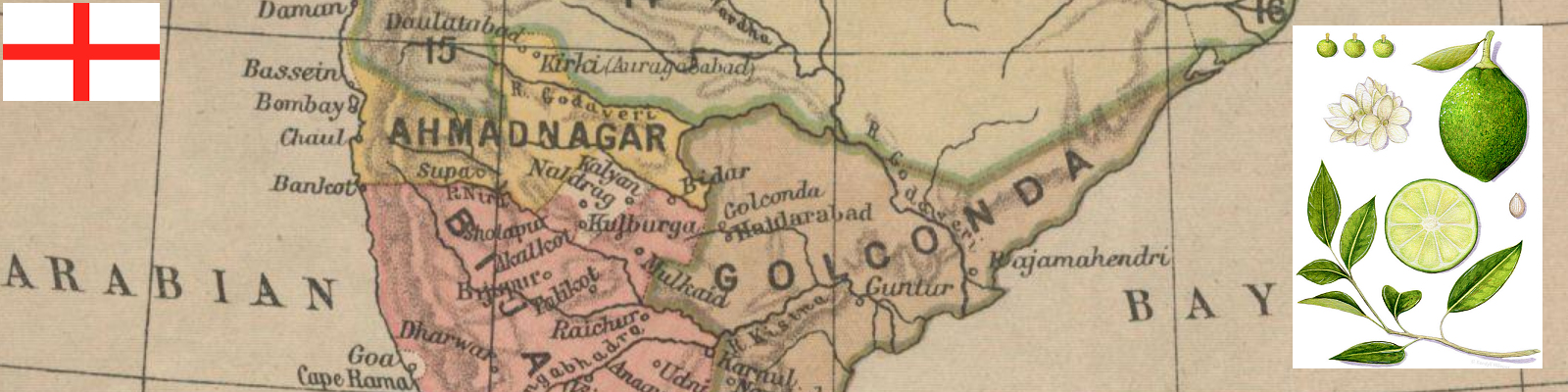
Punch is a product of classic culinary fusion. The English arrivied at the Bombay Islands (now a man-made penninsula), and the Konkan coast of India with the culture of mixing alcohol with other types of ingredients. Because the English did not have their own wine-producing industry, English culture seems have been obly moderately affected by the continental feeling that wine had been perfected since the Fall of Rome – and the assumption that it should no longer be mixed with other ingredients. In this, the English, more than other Western cultures, continued the Greco-Roman practice of often mixing wine and liquor with other sorts of ingredients before drinking it.
In India, that practice met a plentiful supply of sour citrus, namely in the form of the true lime (Ctirus aurantiifolia). It would have odd for the English not to have rather quickly tried mixing the juice of the lime with liquor. It was a success of culinary fusion – the application of an established culinary culture to new ingredients from outside the original terroir of that culture.
The English of Bombay seem to have named the drink from the local Marathi word pach (meaning 'five'), or the Hindi word for the same, paanch, for the five ingredients they used. This may have come from the marketplace talk, requesting or answering, the request for something like "the five things" that the English (or their hired houseboys) repetitively sought.
Englishmen returning to Britain from India, brought Punch-making with them. THough any citrus in England was an imported item, the lemon (Citrus limon) was less difficult to obtain there than the lime. By the 1700, or so, the making of Punch in England with lemon juice was becoming popular. After the shift to the lemon in most Punches made outside the tropics, those Punches made with limes came to be called, "Punch-royal." This may have been evocative of the status of Bombay being a direct possession of the English royal family, rather than legally English or British.
Punches became the emblematic English mixed drink. Its spread to the rest of Britain, and throughout the English-speaking world, and even beyond that, by the late eighteenth century.
The sour-sweet-strong balance in Punch become so succesful that it captured a large part of American preference away from that of the largely-native Slings of the United States of America. Many so-called 'cocktails' in American bars are Punches.
* When using Amazon links from this site, a very small fraction might be paid to Elemental Mixology without affecting the purchase price.